Case studies

What we've built

Each case is a short read: how the work was done before, and what runs now.

Trusted by leading refrigerant suppliers

Three refrigerant cylinders standing beside a horizontal bulk storage tank.

Stock is live, every past day is on record, and errors are caught as they happen

Filling plants in different cities reported their work through email and messaging groups. Once a week someone read every message, wrote the numbers down, and tried to match them with the ERP. By the time the numbers were ready, they were already a few days old, and a wrong number was usually found long after the gas had moved.

A stack of bound ledgers beside a single open book, joined at the base.

Purchase invoices and returns are read and posted into the ERP by an agent, with the accountant approving

A refrigerant supplier's purchase invoices are not simple documents. Gas, cylinders, freight and deposits sit on the same paper, VAT is not always one rate, imports arrive in dollars or euros, and returned cylinders come back as their own kind of invoice. All of it was typed into the ERP by hand, line by line.

A close-packed block of grey gas cylinders with one cylinder in the front row picked out in blue.

Sales, customer accounts and market position in one place, with the system pointing out what needs attention

Sales information lived in the ERP, in spreadsheets, and in what the sales team remembered. Management could not see which region was weak or how much of a market was actually being reached, and a customer who had stopped ordering gas was often noticed months later.
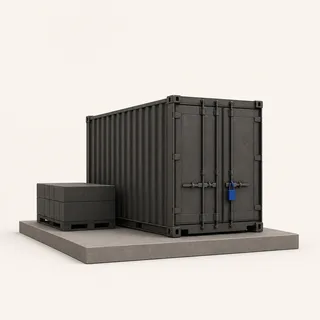
A closed shipping container on a low plinth beside a loaded pallet, with a single blue seal on the door.

Every incoming shipment is followed checkpoint by checkpoint, and the right people are told automatically

This refrigerant supplier brings its stock in as imports, and those imports were followed by asking. Someone called or wrote to someone else, waited for an answer, and passed it on. Anyone who needed the same information started by asking the same people again, and by the time it reached planning it was already old.

An open shelving wall of stacked stock with one compartment holding a single part.

Quotes are prepared automatically from each customer's own history, ready for the salesperson to review

Our client, a refrigerant supplier, could only give a customer a price during working hours, by phone, message or visit. Every request took a salesperson away from other work, and the same numbers were looked up again and again: which gases and cylinder sizes this customer takes, what they paid last time, what their agreement says, what they owe.

Three industrial plant buildings joined at their bases by one continuous pipe.

A company brain that already knows the answer, so people stop asking each other

At a refrigerant supplier we work with, answering a simple question often meant interrupting two or three colleagues. Someone knew where the file was, someone else remembered what was agreed with the customer about cylinder returns, and a third person had the numbers. Knowledge sat with individuals, and it was lost when they left.

# What we've built

Each case is a short read: how the work was done before, and what runs now.

### A refrigerant supplier

Stock is live, every past day is on record, and errors are caught as they happen

Filling plants in different cities reported their work through email and messaging groups. Once a week someone read every message, wrote the numbers down, and tried to match them with the ERP. By the time the numbers were ready, they were already a few days old, and a wrong number was usually found long after the gas had moved.

Read: <https://veth.io/case-studies/live-stock-tracking>

### A refrigerant supplier

Purchase invoices and returns are read and posted into the ERP by an agent, with the accountant approving

A refrigerant supplier's purchase invoices are not simple documents. Gas, cylinders, freight and deposits sit on the same paper, VAT is not always one rate, imports arrive in dollars or euros, and returned cylinders come back as their own kind of invoice. All of it was typed into the ERP by hand, line by line.

Read: <https://veth.io/case-studies/purchase-invoice-posting>

### A refrigerant supplier

Sales, customer accounts and market position in one place, with the system pointing out what needs attention

Sales information lived in the ERP, in spreadsheets, and in what the sales team remembered. Management could not see which region was weak or how much of a market was actually being reached, and a customer who had stopped ordering gas was often noticed months later.

Read: <https://veth.io/case-studies/sales-reporting-and-crm>

### A refrigerant supplier

Every incoming shipment is followed checkpoint by checkpoint, and the right people are told automatically

This refrigerant supplier brings its stock in as imports, and those imports were followed by asking. Someone called or wrote to someone else, waited for an answer, and passed it on. Anyone who needed the same information started by asking the same people again, and by the time it reached planning it was already old.

Read: <https://veth.io/case-studies/shipment-tracking>

### A refrigerant supplier

Quotes are prepared automatically from each customer's own history, ready for the salesperson to review

Our client, a refrigerant supplier, could only give a customer a price during working hours, by phone, message or visit. Every request took a salesperson away from other work, and the same numbers were looked up again and again: which gases and cylinder sizes this customer takes, what they paid last time, what their agreement says, what they owe.

Read: <https://veth.io/case-studies/automated-quoting>

### A refrigerant supplier

A company brain that already knows the answer, so people stop asking each other

At a refrigerant supplier we work with, answering a simple question often meant interrupting two or three colleagues. Someone knew where the file was, someone else remembered what was agreed with the customer about cylinder returns, and a third person had the numbers. Knowledge sat with individuals, and it was lost when they left.

Read: <https://veth.io/case-studies/company-brain>

## Contact

- Email: <hi@veth.io>
- Home: <https://veth.io/>